
 Kristyn Bryan
f8842674ca
Kristyn Bryan
f8842674ca
|
10 years ago | |
|---|---|---|
| .. | ||
| .gitkeep | 11 years ago | |
| GithubBranches.md | 10 years ago | |
| README.md | 10 years ago | |
| trello_example.png | 10 years ago | |

README.md
Morning Exercise
In this morning's exercise, I want to introduce you to some of the product management tools that you will be encountering on the job and also get you familiar with Trello. You will be using Trello to keep track of your 3rd project (and beyond!).
Agile Development
References can be found here
Agile development uses four clear delivery vehicles to bring structure to any agile project: user stories, sprints, epics, and versions. By working with these vehicles, software teams are able to organize their work such that they can respond to customer feedback and change from the original plan of the project without feeling like the walls have crumbled around them. The ability to change and adapt future plans based on current insights is a hallmark of agility.
Today, we're going to go over how to use user stories and what it looks like to create a sprint. But first...scrum.
Scrum
History of Scrum
References can be found here
Scrum was first defined as "a flexible, holistic product development strategy where a development team works as a unit to reach a common goal" as opposed to a "traditional, sequential approach" in 1986 by Hirotaka Takeuchi and Ikujiro Nonaka in the New Product Development Game.[5] Takeuchi and Nonaka later argued in The Knowledge Creating Company[6] that it is a form of "organizational knowledge creation, [...] especially good at bringing about innovation continuously, incrementally and spirally".
They called this the holistic or rugby approach, as the whole process is performed by one cross-functional team across multiple overlapping phases, where the team "tries to go the distance as a unit, passing the ball back and forth".[7] (In rugby football, a scrum refers to a tight-packed formation of players with their heads down who attempt to gain possession of the ball.[8])
As developers, you will work with your team (developers, product managers, project managers, designers, etc.) to get a product out. With the Scrum method, everyone works on the same team and focuses on what needs to be done to reach the final goal.
Daily Scrum
This might look familiar - we do a version of this during your project week:
Each day during a sprint, the team holds a daily scrum (or stand-up) with specific guidelines:
All members of the development team come prepared. The daily scrum...
...starts precisely on time even if some development team members are missing
...should happen at the same time and place every day
...is limited (timeboxed) to fifteen minutes
Anyone is welcome, though normally only scrum team roles contribute. During the daily scrum, each team-member answers three questions:
- What did I do yesterday that helped the development team meet the sprint goal?
- What will I do today to help the development team meet the sprint goal?
- Do I see any impediment that prevents me or the development team from meeting the sprint goal? Any impediment (stumbling block, risk or issue) identified in the daily scrum should be captured by the scrum master and displayed on the team's scrum board, with an agreed person designated to working toward a resolution (outside of the daily scrum). No detailed discussions should happen during the daily scrum.
Using a tracker in Scrum Development
There are a few different tools that can be used to plan scrum development. We're just going to look at briefly at two of them, but here's a more comprehensive list of what might be used and the features that come with them.
Jira

Trello
We're doing small applictions and don't need all the fancy stuff that comes with Jira, so we'll use Trello to mimic the flow that most of you will be using during production!
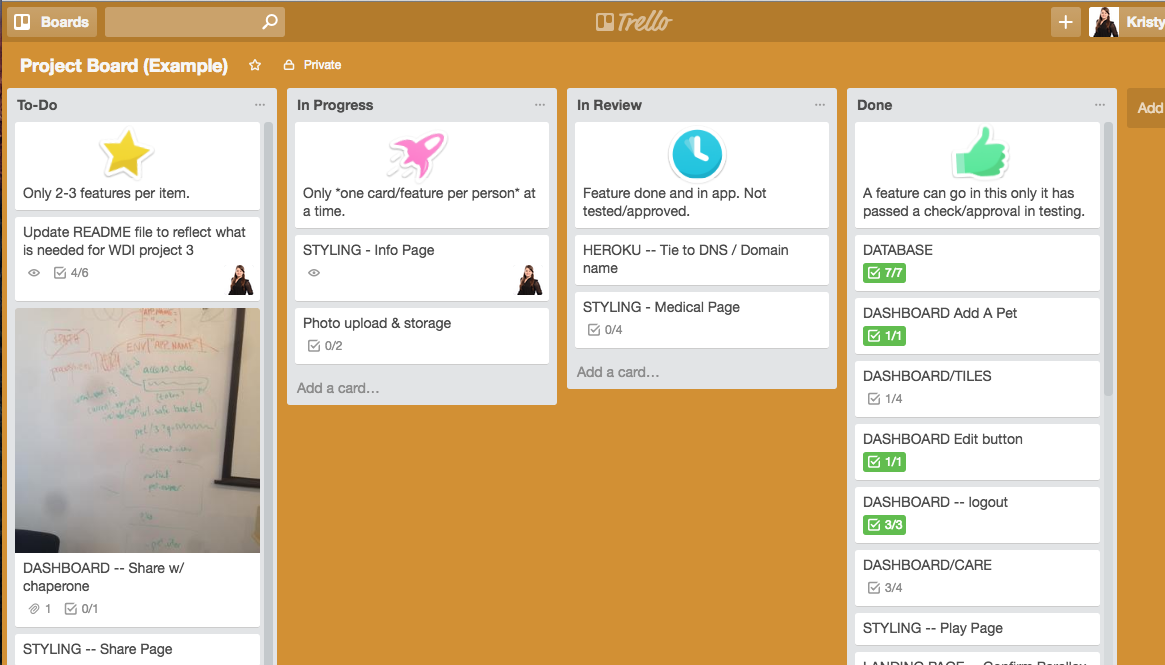
Each column is referred to as a "list" and inside the list sit "cards". Each of these cards is meant to contain information to create one feature of your application. Only one person may take ownership of a card AND only one card should be claimed at a time. Depending how you decide to do this with your team, each card may also represent a branch in Github (this is how it works in Jira).
Scrum poker
References can be found here
Planning poker, also called Scrum poker, is a consensus-based, gamified technique for estimating, mostly used to estimate effort or relative size of development goals in software development. In planning poker, members of the group make estimates by playing numbered cards face-down to the table, instead of speaking them aloud. The cards are revealed, and the estimates are then discussed.
If you are doing this remotely, you will count to three and then throw up your fingers (or hold up your cards OR use the calculator on your smartphone to display your number) to show your number estimation (kind of like rock, paper, scissors).
By hiding the figures in this way, the group can avoid the cognitive bias of anchoring, where the first number spoken aloud sets a precedent for subsequent estimates.
How to play
Planning poker is based on a list of features to be delivered, several copies of a deck of cards and optionally, an egg timer that can be used to limit time spent in discussion of each item.
The feature list, often a list of user stories, describes some software that needs to be developed.
The cards in the deck have numbers on them. A typical deck has cards showing the Fibonacci sequence including a zero: 0, 1, 2, 3, 5, 8, 13, 21, 34, 55, 89.
Why is the Fibonacci sequence used? There are many opinions on this and I've linked them here. Ultimately, I think that it's because it helps to represent the hours that it might take to complete the work. Something that might be a 1 would take you 2 hours while something that is a 3 would take you 6 hours... not just 1 extra hour, etc.
Doing planning poker will help you figure out how long your overall plan will take, sets time aside to discuss any unforseen problems before coding begins, and also might help you figure out who to assign to which task.
Activity
You will be paird up and will need to do the following to set up a Trello board that you can use for a pretend application:
-
Individually, create a Trello account: www.trello.com
-
When making your Trello account, be sure to take note of your screenname OR update the screenname that they automatically assign to you to something that you will remember (and that is at least semi-professional).
-
With your partner, decide who will initially create the Trello board.
-
Create the lists for "To-Do", "In Progress", "In Review", and "Done".
-
With the following user stories, create cards (issues) under "To-Do" that split up the work into pieces that can be individually tackled. You will literally be creating Github issues for these once you complete one before you merge it into your master repo. EXAMPLE: The user should be able to upload a profile picture. You might break the issues up as follows: "Photo Upload - install Paperclip", "Photo Upload - AWS API integration", or "Photo Upload - research how to do this" USER STORIES
-
Discuss which cards that you'd like to take and work on for your first stab at the project. It's advisable to select things that won't have you working inside the same file - this way you won't have merge conflicts (so perhaps somene can do some styling while the other person works on some logic). Add yourself to the card (
Members) and move it over to the "In Progress" List. -
Have you run into any issues? Can you see how this might be advantageous to use when working with other people?
-
If you have extra time, try giving Scrum poker a try on your cards and assign them a value. Because you're doing this remotely (and I've seen this done in multiple settings even in-person), you will count to three and then throw up your fingers to show your number estimation (kind of like rock, paper, scissors). If your numbers are totally off (one of you throws a 1 and the other throws a 5), you can each discuss why you assigned it that number.