
Pandas I
Learning Objectives
After this lesson, you will be able to:
- Use Pandas to read in a dataset.
- Investigate a dataset's integrity.
- Filter, sort, and manipulate DataFrame series.
What is Pandas?
- A group of adorable bears 🐼🐼🐼
- A Python library for data manipulation.
So, Pandas the Library
The Swiss Army Knife of data manipulation!
Pandas:
- Is the library for exploratory data analysis (EDA).
- Formats, wrangles, cleans, and prepares our data.
Quick Backstory from 2009:
- A humble open source project for Panel Data (hence "Pandas") from Wes McKinney.
- Now the most used Python-related tag on Stack Overflow.
Exploratory Data Analysis (EDA)
The process of understanding our dataset and producing our first level of insights.
This includes:
- Reading in data: "Import dog population."
- Checking data types. "Is the population count in integers?"
- Renaming columns: "
dog_breed is more helpful than Biological Family"
- Joining together data: "Join the dog population data with the cat population data."
- Looking for missing data: "It doesn't mention corgis."
- And more!
Today, we will focus on the most 'mission critical' elements of EDA.
Quick Review
- Exploratory Data Analysis (EDA) is the process of understanding our dataset, and producing our first level of insights.What does this include?
- Pandas is a prominent Python library used for exploratory data analysis
What dataset are we exploring?
Take a look at the data source page.
Discussion: What Could We Examine?
-
What are some potential insights you'd like to uncover given Iowa liquor data?
-
What if you are examining it from the standpoint of the Iowa government?
-
What if you are a potential liquor store business owner?
---
Our Modified Iowa Liquor Dataset
The full dataset is all liquor sales from 2012 to present.
There are more than 13 million rows (13,948,103+ at the time of writing)!
We will work with a modified dataset.
Key changes:
- Only sales from May 2017 and May 2018
- Intentionally deleted:
- A number of values, to practice missing data.
- An arbitrary subset of entire observations, to shrink it.
- A few columns, to simplify.
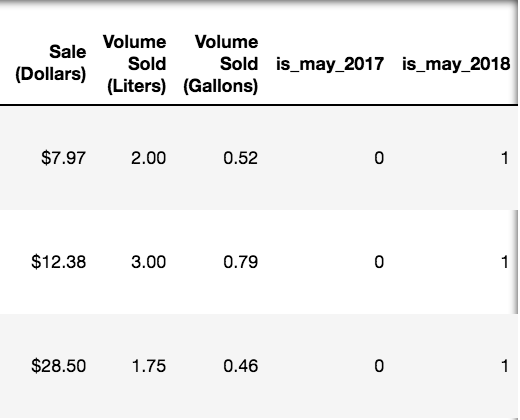
The First Few Rows
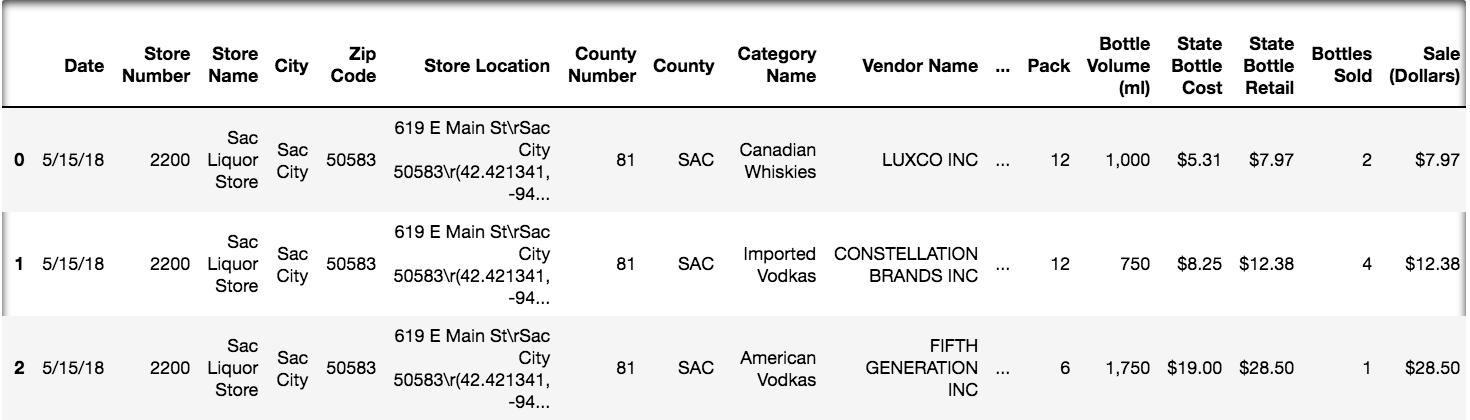
The First Few Rows (Ctd)
Data Integrity
The first thing we check! Assuring our data can be trusted to produce meaningful insights.
Correctly formatted datatypes.
- "Decimals are floats, not strings."
Representative sample for the underlying population of interest.
- "Did we sample sales in cities or across the whole state?"
Missing Data
- "Why do we only have even days of the month?"
No sampling or human bias.
- "Did we only consider liquor sales of specific varieties?"
Clean Truth about Dirty Data
-
Assessing data integrity isn't a one-stop step.
-
Much like EDA itself, it's an ongoing process!
-
We uncover additional potential problems and anomalies to remedy along the way.
Launch our notebook
We'll work in the Notebook
- We're fledgling data scientists!
The .ipynb file you will open is called " pandas-i.ipynb ".
Open it up!
Jump down to Importing Pandas.
Additional Resources
