
10 KiB
Next Steps in Data Science
Learning Objectives
After this lesson, you will be able to:
- Identify core libraries in the data science ecosystem.
- Determine how to learn more about which area is most interesting to you!
- Discuss hiring in the data science job market and strategies to support a search.
Celebrate
Reflect for a moment - you've:
- Learned the fundamentals of Python, from data types to object oriented programming.
- Used your first API to build a simple application.
- Applied Pandas to synthesize insights from datasets.
That's a lot! It deserves a huge congratulations.
Discussion: Introspection
-
What did you enjoy most?
-
What did you find most intriguing?
-
What do you want to know more about?
-
What caused the most struggle?
This isn't an all-frills exercise. It helps inform your future data science growth!
Revisiting the data science process
It's important to place our Pandas work into the broader picture of data science.
To do so, recall our data science workflow:
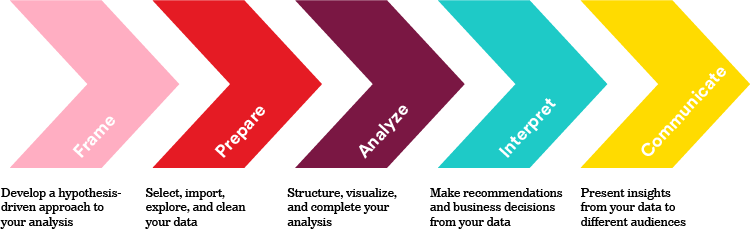
Discussion: Condensed Workflow
- Identify the problem
- Acquire the right data
- Parse the data
- Mine our data
- Refine our data
- Build a model
- Present our work
Class Question: Where have we focused our work?
Where we focused
- Identify the problem
- Acquire the right data
- Parse the data. We did this! Remember the Adventure Works Production.Product dictionary? Did you revisit IMDB's source to understand any columns?
- Mine our data. We did this! Checked subpopulation analyses and, perhaps, feature creation. We filtered to a specific county; potentially creating our own IMDB v Rotten Tomato metrics.
- Refine our data. We did this! We mutated our data using the .apply() method to modify prices and color of products.
- Build a model
- Present our work
Where we did a bit
- Identify the problem. We did a bit! Identify your own question about IMDB data, and answer it.
- Acquire the right data. We did a bit! Using the OMDBApi to obtain Rotten Tomato data for our IMDB dataset.
- Parse the data
- Mine our data
- Refine our data
- Build a model
- Present our work. We did a bit! Maintaining clean Jupyter Notebooks (right?) and creating takeaway visualizations.
Whew! We did cover a lot of ground!
Where we didn't Focus
- Identify the problem
- Acquire the right data
- Parse the data
- Mine our data
- Refine our data
- Build a model. We never did this!
- Present our work
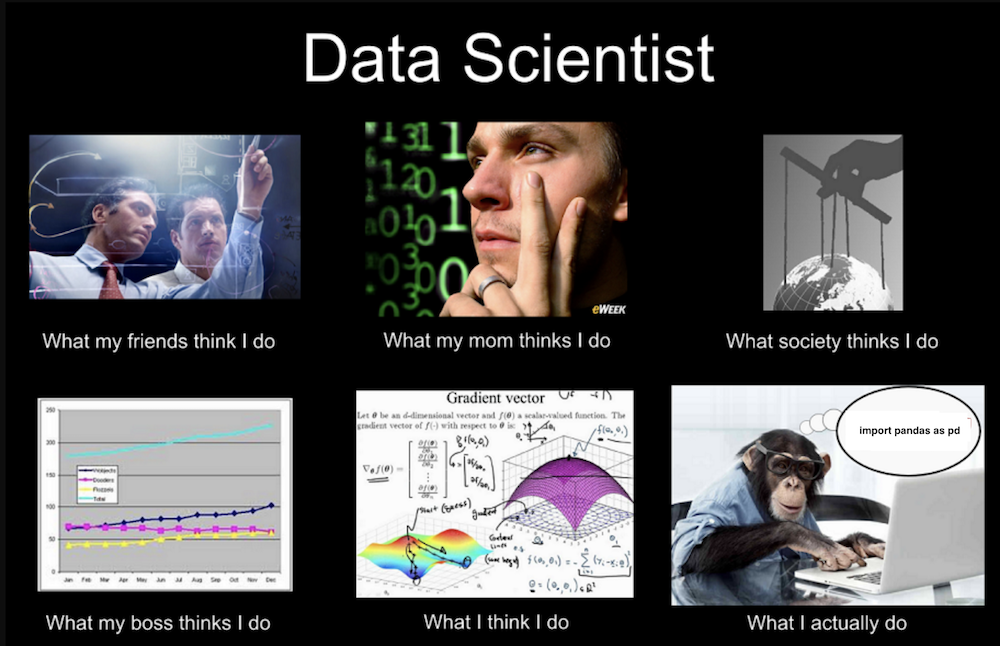
"Hey! I thought that's all data science is! Machine learning artificial intelligence neural networks [on the blockchain]!"
The truth about data science
- Exploratory data analysis is typically 80% of a data science problem.
- Modeling is 20%.
What's more:
- The steps you take to set up your models in EDA, ultimately have a outsized impact on the result you will achieve.
Apologies in advance for this one
Exceptions
-
Many companies will structure teams such that some individuals focus 100% of their time on the 20% of the problem which is solved by modeling.
-
We've focused on Pandas EDA.
- The area you can make the greatest impact with.
Python Data Science Package Ecosystem
We know Pandas!
- Awesome!
- Reads in data.
- Exploratory data analysis.
- Munging.
- Wrangling.
- Visualization via matplotlib
What else is there?
Recommend Libraries for DS
Once you're comfortable with Pandas...
- Seaborn:
- Creates visualizations (of greater complexity than Pandas)
- With a few lines of code via
matplotlib
- NumPy:
- Numerical computation, particularly linear algebra.
- SciPy:
- Scientific computation, especially statistics.
- Requests:
- Making web requests - calling APIs!
- Plotly:
- Interactive plots!
Other DS Libraries
Not as ubiquitous or popular, but still good:
- BeautifulSoup:
- Easily parse HTML.
- Statsmodels:
- Traditional statistic inference techniques, like linear regression.
- Scikit-learn:
- All-purpose machine learning model construction.
- NLTK | SpaCy
- Natural language processing.
- TensorFlow | PyTorch | MxNet
- Neural network research and model construction.
- PySpark
- Interacting with big data.
Discussion: What-for-what?
At what step would each library be most helpful?
The data science steps:
- Identify the problem
- Acquire the right data
- Parse the data
- Mine our data
- Refine our data
- Build a model
- Present our work
Discussion: What-for-what?
Match up these libraries:
- Pandas: for reading in data, exploratory data analysis, munging, wrangling, and visualization via matplotlib
- Seaborn: creates visualizations (of greater complexity) with a few lines of code via matplotlib
- Requests: for making web requests
- NumPy: for numerical computation, particularly linear algebra
- SciPy: for scientific computation, especially statistics
Learning More - How?
-
Learn by doing.
- Learning requires consuming and producing. (Perhaps even in 50/50 balance)
-
Consume relevant content about what you want to learn (videos, books, etc).
-
Have frequent projects and exercises to practice.
Learning More - Where?
There's an abundance of resources, which can seem overwhelming, but it's actually a huge benefit.
For self-paced and online programs about a specific area, consider:
- DataCamp
- DataQuest
- Coursera
For instructor-led and guided education, come on back to General Assembly!
- We have expert-led workshops and courses in data science:
- A 10-week part-time data science (60hrs).
- The Data Science Immersive, a full-time, three month program (480hrs).
These classes walk through the full data science lifecycle.
Stretchhhh

-
Stand up, stretch a bit.
-
Or lie down!
-
I'm not a cop.
What Do You Really Need?
Data scientists need three core skills:
- Analytical thinking
- Mathematics and statistics proficiency
- Coding ability
Let's break these down.
Analytical thinking
-
How well can you structure a data science problem / target an analysis for high impact output?
-
Do you select metrics that align with those goals?
-
Do you break a big problem into manageable, component parts?
Class Question:
- Imagine you are a data scientist at Facebook.
- Users list high schools they attended - some real, some fake.
How could you verify that a given high school a user listed is the one they attended? How would you measure success?
Mathematics and statistics proficiency
Can you apply fundamental maths and stats to problem solving? Do you have a firm understanding of probability? Linear algebra?
Class Question:
- There are 52 cards in a deck.
- 26 are red, and 26 are black. The 52 cards make up four suits (hearts, diamonds, spades, clubs).
- There are 13 of each suit (ace-10, jack, queen, king).
- It is a fair deck of cards.
What is the probability of drawing the 4 of spades OR a club? What is the probability of drawing any 3 OR a spade?
Coding ability
- Can you write readable, maintainable, efficient code?
- Can you translate your thinking skills into programmatic thinking?
- Do you know Python, R, SQL, and/or Scala? (Yes, you do!)
Question:
Do you recall Fizzbuzz? Try writing it again here from scratch.
Open a new Python file, fizz.py.
- Write a program that prints the numbers from 1 to
n(passed in). - But, for multiples of three, print “Fizz” instead of the number.
- For multiples of five, print “Buzz”.
- For numbers which are multiples of both three and five, print “FizzBuzz”.
Establishing Yourself as a Data Scientist
-
Start a blog. - Blogs are incredibly common in technology. - They demonstrate your learning process.
-
Share with your network. - Keep your friends and coworkers engaged on what you're doing and learning. - Opportunities are sometimes spurious.
-
Attend Meetups and other networking opportunities to learn, meet, and share.
Summary:
- There are many paths you can go!
- Check the Additional Reading for links to libraries. - You probably want Seaborn, NumPy, or SciPy.
- Work on your core skills!
- Analytical thinking.
- Mathematics and statistics proficiency.
- Coding ability.